What Is My Learning Style? A Simple Guide to Finding Out
Have you ever found yourself wondering, "What is my learning style?" You're not alone. Millions of people struggle to absorb new information simply because they haven't figured out how their brain naturally processes it.
The truth is, we don't all learn the same way. Some people need to see it. Others need to hear it. And some people only truly "get it" when they can touch it, move with it, or do it themselves.
Understanding your learning style is like finding the right key for a lock. Once you know it, everything from studying for exams to picking up new skills at work becomes dramatically easier.
In this guide, we'll walk you through the four main learning styles, show you how to identify yours, and give you practical tips to start learning smarter today.
What Are the Four Learning Styles?
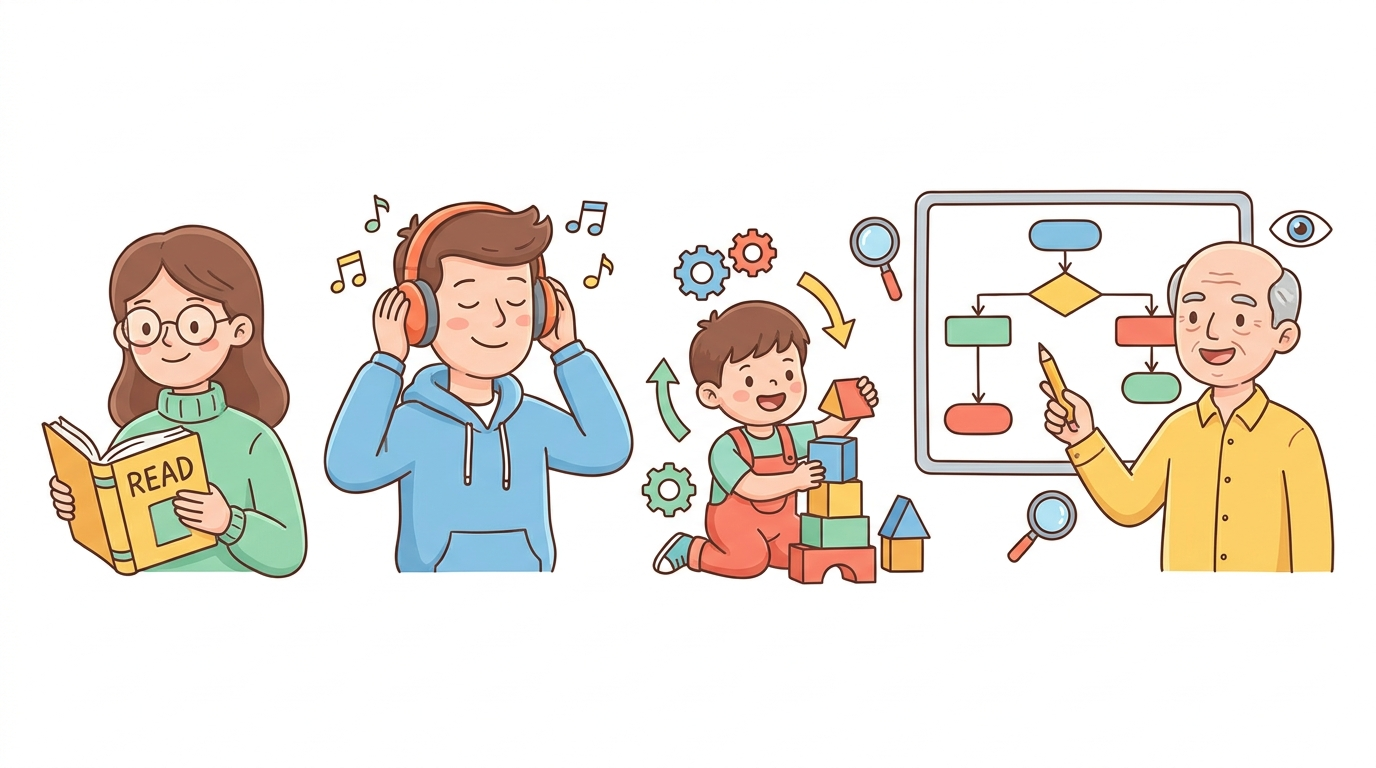
The most widely used framework for understanding how we learn is called the VARK model. It breaks learners into four categories: Visual, Auditory, Reading/Writing, and Kinesthetic.
Nobody fits perfectly into just one box. Most of us have a dominant style with one or two secondary styles that support it. But knowing your primary style gives you a huge advantage.
Let's look at each one.
Visual Learners
Visual learners absorb information best when it's presented in a visual format — charts, diagrams, infographics, color-coded notes, and mind maps. If you're someone who remembers faces better than names, or who "sees" information in your mind's eye, you might be a visual learner.
Auditory Learners
Auditory learners process information by hearing it. Lectures, podcasts, group discussions, and even talking through a problem out loud all work wonders here. If you find yourself humming song lyrics after hearing them once, or remembering exactly how someone said something, auditory might be your style.
Reading/Writing Learners
Reading and writing learners thrive on text. They love articles, books, lists, and written notes. This style was added to the original three (visual, auditory, kinesthetic) to capture people who learn best through words — whether reading them or writing them down.
Kinesthetic Learners
Kinesthetic learners need to move, touch, and do. They learn through hands-on experience, physical activity, and trial and error. If you've ever taken something apart just to see how it works, or if you can't sit still during a long lecture, you might be kinesthetic.
Signs That Point to Your Learning Style
Still asking yourself, "What is my learning style?" Here are some quick clues that can help you narrow it down:
- You're probably visual if you prefer diagrams over paragraphs, doodle during meetings, and remember where things are on a page.
- You're probably auditory if you talk through problems, remember spoken instructions better than written ones, and enjoy podcasts and audiobooks.
- You're probably a reading/writing learner if you love making lists, taking detailed notes, and reading articles like this one.
- You're probably kinesthetic if you learn by doing, fidget when sitting still, and prefer lab work or hands-on projects to lectures.
These are just starting points. The most reliable way to know for sure is to take a proper learning style assessment.
Why Knowing Your Learning Style Matters
You might be thinking — does this really make a difference? Absolutely. Here's why.
When you align your study methods with your natural learning style, you retain more in less time. You stop fighting your brain and start working with it. A visual learner staring at a wall of text will struggle. But give that same person a flowchart, and the concept clicks instantly.
It also helps you communicate better. If you know your child is a kinesthetic learner, you can stop expecting them to sit quietly and read for an hour. Instead, you can incorporate movement and hands-on activities into their homework routine.
At work, understanding your colleagues' learning styles makes meetings more productive. You'll know when to send a written summary versus when to talk something through.
How to Find Out for Sure
You could spend weeks observing yourself and guessing. Or you could take a learning style quiz that gives you a clear answer in minutes.
A good quiz asks about your real-world preferences — how you handle new information, what study environments feel natural, and how you recall things. Based on your answers, it identifies your dominant style and gives you personalized tips.
The key is to answer honestly. Don't pick what you think sounds smart. Pick what actually feels right. There are no wrong answers — just your answers.
Quick Tips for Each Learning Style
Once you know your style, here are some quick wins:
If you're visual: Use color-coding, draw diagrams, watch video tutorials, and turn notes into mind maps.
If you're auditory: Record lectures and listen back, study with a partner and discuss concepts out loud, and use mnemonic songs or rhymes.
If you're reading/writing: Rewrite your notes in your own words, make summary sheets, and read textbook chapters before and after class.
If you're kinesthetic: Build models, act out concepts, take frequent movement breaks, and use physical objects to represent abstract ideas.
Common Myths About Learning Styles
Let's clear up a couple of misconceptions.
Myth: You can only have one learning style. Reality: Most people are multimodal. You likely have a dominant style but benefit from a mix of approaches.
Myth: Learning styles are fixed. Reality: Your style can shift depending on the subject, your environment, and even your age. The goal is flexibility, not rigidity.
Myth: Matching your style guarantees success. Reality: It helps — a lot — but effort, consistency, and good study habits still matter. Think of your learning style as a tool, not a magic wand.
Start Learning Smarter Today
Figuring out your learning style isn't about putting yourself in a box. It's about understanding how your brain works so you can stop wasting time on methods that don't fit.
Once you know whether you're visual, auditory, reading/writing, or kinesthetic, you can tailor everything — your study routine, your work habits, even how you explain things to others. It's one of the highest-impact changes you can make for your learning journey.
Ready to find your learning style? Take our free quiz →