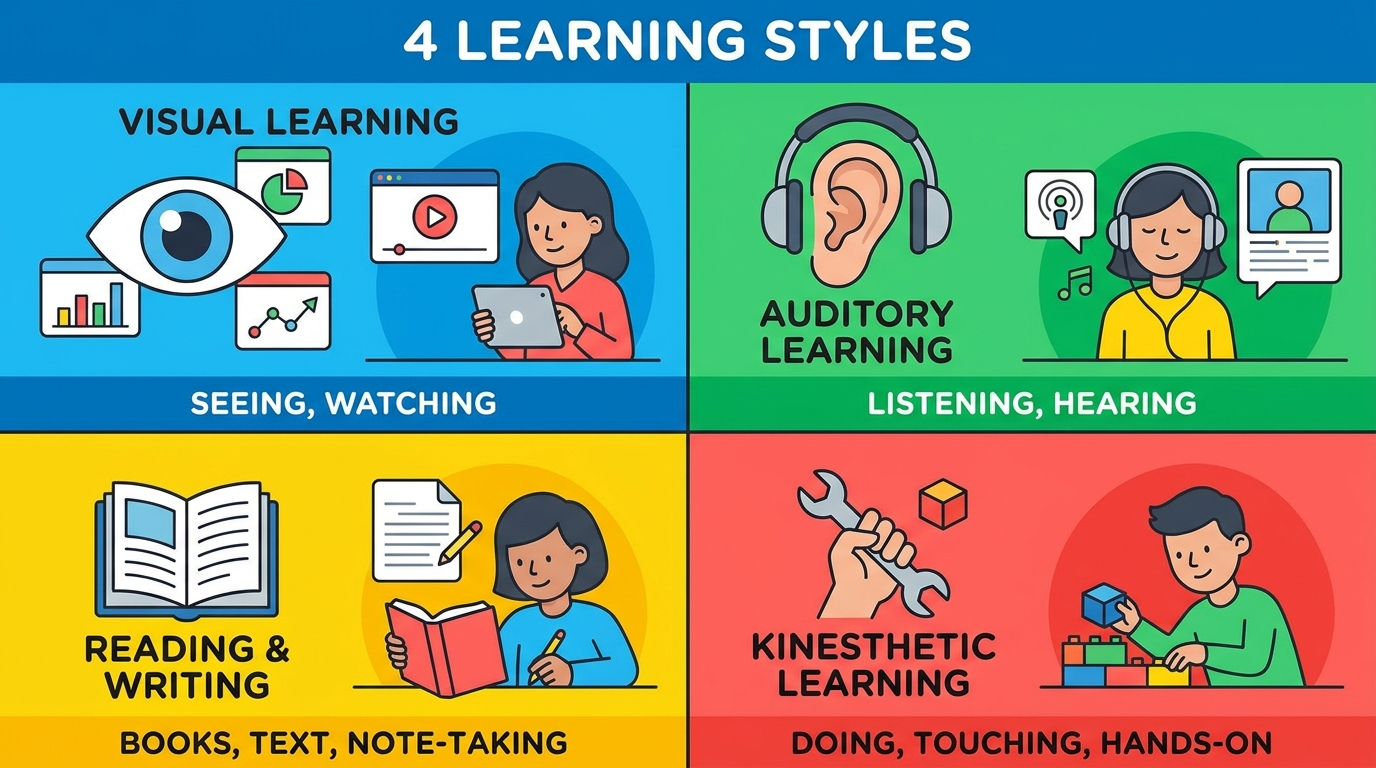
Visual, Auditory, Kinesthetic: Understanding the 4 Learning Styles
You've probably heard the terms visual, auditory, kinesthetic — maybe in a teacher's comment about your child, or in a productivity article at work. But what do they actually mean, and why do they matter?
The idea is simple: we don't all process information the same way. Your brain has a preferred channel for taking in new information, and when you use that channel, learning becomes faster, easier, and more enjoyable. When you don't, it feels like pushing a boulder uphill.
In this article, we'll break down all four learning styles — including the fourth one many people forget — so you can understand yourself, your kids, and your colleagues better.
The VARK Model: A Quick Overview
The framework most people use is called VARK, developed by educational researcher Neil Fleming. VARK stands for:
- Visual
- Auditory
- Reading/Writing
- Kinesthetic
Most people have one dominant style, with one or two secondary styles. Nobody is purely one type, but knowing your primary channel helps you choose study methods, tools, and environments that actually work for you.
Let's look at each one in detail.
Visual Learners: "Show Me"
Visual learners process information best when they can see it. They thrive on charts, diagrams, maps, videos, and visual demonstrations. Text-heavy materials without any visual structure can feel overwhelming to them.
Signs You're a Visual Learner
- You remember faces better than names
- You prefer infographics over long articles
- You doodle or draw during meetings
- You notice visual details others miss
- You struggle with spoken-only instructions
Best Study Strategies for Visual Learners
If you're visual, lean into color and spatial organization. Use color-coded highlighters, draw mind maps and concept diagrams, and watch video tutorials instead of reading transcripts.
Turn text into visuals: convert a list of historical events into a timeline, or turn a process into a flowchart. The act of creating the visual deepens your understanding, and the visual itself becomes a memory aid.
Auditory Learners: "Tell Me"
Auditory learners absorb information through hearing. Lectures, discussions, podcasts, and audio recordings all work beautifully for them. They often think in words rather than images and may talk to themselves when working through a problem.
Signs You're an Auditory Learner
- You remember what people say, including tone and phrasing
- You learn well from lectures and discussions
- You read aloud or move your lips while reading
- You enjoy podcasts and audiobooks
- You hum or talk through problems to solve them
Best Study Strategies for Auditory Learners
Record lectures and listen back to key sections. Study with a partner and take turns explaining concepts out loud. Use mnemonic devices with rhythm or rhyme — your brain latches onto auditory patterns.
When reading, try summarizing each section out loud in your own words. It feels odd at first, but for auditory learners, hearing yourself explain something is one of the most powerful retention tools available.
Reading/Writing Learners: "Let Me Read It"
This is the fourth style that often gets left out when people say "visual, auditory, kinesthetic." Reading and writing learners process information best through text — reading it, writing it, or both.
These learners excel with articles, books, note-taking, and written summaries. They're often the people who learn best from a textbook chapter or a well-structured article (like this one!).
Signs You're a Reading/Writing Learner
- You take detailed, organized notes
- You prefer reading instructions over watching a video
- You rewrite your notes to study
- You make lists and love a good article
- You remember information by where it appeared on a page
Best Study Strategies for Reading/Writing Learners
Rewrite your notes in your own words after each session. Create summary sheets and study guides. Read textbook chapters before and after class to reinforce concepts.
Use text-based tools like flashcards with written Q&A formats. The act of writing and re-reading is where the magic happens for this style.
Kinesthetic Learners: "Let Me Do It"
Kinesthetic learners need physical engagement. They learn by doing — touching, moving, building, and experimenting. Sitting still through a long lecture is their personal torture.
These learners often excel in lab work, sports, art, and anything hands-on. They remember what they did far better than what they heard or read.
Signs You're a Kinesthetic Learner
- You fidget or need to move while thinking
- You take things apart to understand them
- You learn best through experiments and hands-on projects
- You struggle to sit still for long periods
- You gesture a lot when talking
Best Study Strategies for Kinesthetic Learners
Incorporate movement into your studying. Walk while reviewing flashcards. Build physical models of concepts. Act out historical events or scientific processes. Use objects you can manipulate — blocks, puzzles, props.
Take frequent movement breaks — every 20–30 minutes, stand up, stretch, move around. Your brain actually processes information better when your body is engaged.
Can You Have More Than One Style?
Absolutely. In fact, most people are multimodal. You might be strongly visual with a secondary auditory preference. Or you could be a reading/writing learner who also benefits from kinesthetic activities.
The goal isn't to fit neatly into one box. It's to understand your natural tendencies so you can choose the study methods that work best for you. The more channels you can engage, the deeper your learning becomes.
Why Understanding Learning Styles Helps
When you know your learning style — and your child's — everything gets easier. Homework battles decrease. Study time shrinks. Information sticks.
You stop forcing yourself (or your child) to use methods that don't fit. Instead, you tailor your approach to how your brain naturally works. It's one of the simplest, highest-impact changes you can make.
The key is knowing which style is yours. And the fastest way to find out is a proper assessment.
Ready to find your learning style? Take our free quiz →